

2013-2018 6.7L Cummins DPF & EGR Delete: 4" or 5" — How to Choose Yours
For the vast majority of 2013-2018 6.7L Cummins owners, a 4" pipe is the right call. The 5" is not “better” in any automatic sense — it’s louder, deeper, pricier, and harder to fit, and it only earns its keep on a high-output competition build where the extra cross-sectional area is actually being used.
The mistake almost everyone makes is treating exhaust diameter like a horsepower dial, where bigger always equals better. It doesn’t work that way on a diesel. The pipe is only one link in a chain that starts at the turbo’s outlet and ends at the tailpipe — and if the turbo outlet, the downpipe, the tune, and the fuel delivery aren’t all sized to match, a bigger pipe downstream just buys you more cab drone and a lighter wallet.
The 6.7L Cummins 4" vs 5" Decision, Laid Out in Full
There are two completely separate questions hiding inside “4 inch or 5 inch,” and you need to answer both before you spend a dollar. The first is about how the pipe performs, and the second is about how it sounds and fits in your actual truck.
Question 1: Does The Pipe Flow Enough For Your Build?
4-inch Exhaust:
A 4" exhaust flows enough for essentially every street-driven, towing, and mild-to-moderate tune combination a 6.7L Cummins will ever see. The factory DPF and catalyst are the real restriction — the difference between a clogged, backpressure-heavy emissions stack and a straight 4" pipe is enormous.
5-inch Exhaust:
A 5" exhaust only becomes relevant when you’re pushing real power — big single or compound turbos, a high-flow injection setup, a tune that’s asking for 600+ horsepower at the crank, and sustained wide-open-throttle duty. At those flow rates, the extra cross-sectional area matters because it reduces backpressure and lets exhaust heat escape faster.
A 5" pipe does not, by itself, give you more towing torque.If your turbo’s outlet, your downpipe, your bends, and your calibration aren’t all sized to move that much gas, you won't see those performance gains. Payload, tow rating, turbo health, fuel delivery, and EGT control do not increase because the exhaust hardware got bigger — those are functions of the whole system.
A good way to think about it: 4" is the default. 5" is the upgrade you make after you’ve already built everything upstream of it to actually need the flow.
Question 2: How Does It Sound, And Will It Fit You?
This is where real-world owners disagree the most, and it’s worth listening to the people who’ve actually run both.
-
5" straight pipe = a bassier, deeper, louder tone. Owners describe it as “like a jet,” “like a roaring lion,” an 18-wheeler on full song. It’s glorious at idle and under load.
-
4" straight pipe = more of a rasp to it, a slightly sharper, brighter bark. Still very loud compared to stock, but with a different character.
The cab drone:
The 5" pipe resonates inside the cab at highway speed — a low-frequency hum and vibration that the 4" pipe produces far less of. If you do a lot of long highway miles, or you tow for hours at a stretch, that drone is not a small thing. The fix — adding a muffler or resonator — tames it, but then you’ve spent 5" money to sound like a muffled 4".
One More Fitment Reality:
The 5" pipe is physically harder to route. The larger tubing is less forgiving around crossmembers, the spare tire, shocks, heat shields, and body seams. It needs more clearance and more patience during install. The 4" slips in with noticeably less drama.
The decision table
| Your situation | Pick 4" | Pick 5" |
|---|---|---|
| Daily driving, towing, work truck | ✓ | |
| Mild-to-moderate tune (stock to ~500 hp) | ✓ | |
| You want the loudest, deepest tone possible | ✓ | |
| High-output competition build (600+ hp) | ✓ | |
| Long highway miles, drone-sensitive | ✓ | |
| Budget-conscious (want the most gain per dollar) | ✓ | |
| Chasing maximum EGT reduction under heavy load | ✓ |
The honest bottom line:
If you’re coming from a stock truck, the jump to a 4" straight pipe already feels like a different engine. The 5" is for the person who specifically wants the biggest, deepest sound and is willing to live with drone — or the person who’s genuinely built the engine to need the flow.
Why the 2013-2018 6.7L Cummins Is the Delete Sweet Spot
Before we dig into the parts and the process, it’s worth understanding why this specific generation is the most deleted diesel on the road — because it explains both the appeal and the one thing you still have to get right.
What This Generation Actually Is
When you see a 2013-2018 truck, you’re looking at the first full-emissions 6.7L — EGR, DOC, DPF, SCR, and DEF all present and accounted for. Before 2013, the 2007.5-2012 trucks ran EGR and DPF only — no DEF tank, no SCR catalyst, no DEF injector.
That’s the bad news: it’s the first generation carrying the complete emissions burden. But it’s also the good news, because it’s paired with the most reliable fuel pump Cummins ever put in these trucks.
The CP3 Pump Is The Quiet Hero Here
This is a detail that matters a lot and gets muddled constantly. The 2013-2018 trucks run the Bosch CP3 high-pressure fuel pump — the “old reliable” pump that earned its reputation over a decade. The CP4 nightmare only hit the 6.7L Cummins in 2019-2020, and Ram recalled those trucks back to the CP3.
The point for a 2013-2018 owner: your engine’s fuel system is already the good one. You’re not deleting a truck that’s hiding a CP4 time bomb. You’re deleting a truck whose emissions system is the annoyance, while the engine itself is solid. That’s a very different value proposition.
The Emissions System Is The Annoyance, Not The Engine
A Cummins-certified heavy-duty mechanic put the 6.7L’s issues in blunt order, and it tracks with everything else we reviewed:
-
Aftertreatment issues are the number-one problem, full stop. Sensors, wiring, DEF pumps, DPF failures, SCR failures — the whole system is heat-soaked, sensor-dense, and prone to throwing derate codes that require dealer software to diagnose.
-
EGR problems come second — EGR coolers clogging with soot, EGR valves sticking, check-engine lights from pressure sensors reading wrong.
-
VGT turbo actuator seizing is a distant third.
That’s the real reason the 2013-2018 deletes so well: you’re removing the weak link and keeping the strong one.
What the Emissions System Actually Does — Why It Fights Itself
To understand what a delete actually changes, you need a one-minute picture of what these systems do — because they don’t just sit there passively. They work against each other in a way that directly causes the problems you’re trying to solve.
A diesel engine emits two things: soot (black smoke, diesel particulate matter) and NOx (nitrogen oxides, invisible but more toxic). And here’s the cruel irony baked into the design: the two are in a permanent tug-of-war.
- Hot combustion = more NOx, less soot (you burn cleaner).
- Cool combustion = less NOx, more soot (you don’t burn as efficiently).
The emissions systems exist to fight both at once, and they end up tripping over each other:
-
EGR (exhaust gas recirculation) routes some exhaust back into the intake to cool combustion and cut NOx. But it also makes the engine less efficient — more unburned fuel, which means more soot.
-
DPF (diesel particulate filter) traps that soot. But it fills up, so the truck runs a regeneration — dumping fuel and spiking temperatures past 1,000°F to burn the soot out.
-
But regen raises combustion temps, which creates more NOx — undoing what the EGR just did.
-
SCR + DEF then sprays urea (ammonia) into the exhaust to convert that NOx back into harmless nitrogen and water.
One component’s solution is another component’s problem. And every single link in that chain — the EGR cooler, the DPF, the DEF heater, the two dozen sensors — is a failure point that can derate your truck. That’s why a delete isn’t just “more power.” It’s removing an entire category of failure modes that have nothing to do with the engine’s actual health.
What a Delete Actually Eliminates (The Real Failure Chain)
Let’s be precise about what you’re fixing, because “delete = more horsepower” is only half the story — and arguably the less important half.
The EGR cooler is a ticking clock
The EGR cooler on the 6.7L is a heat exchanger that runs hot exhaust through coolant passages. Over thousands of heat cycles, it’s the single most common physical failure point on this platform. Two things go wrong:
-
It clogs with soot — the internal fins pack full of carbon, the pressure sensors read wrong, and you get a check-engine light and derate.
-
It cracks — a cracked EGR cooler lets exhaust pressure push into the cooling system. The symptom looks exactly like a blown head gasket: overheating, coolant loss, sweet smell in the engine bay. People spend a fortune chasing a head gasket diagnosis when the real culprit is a $300 delete parts.
The EGR valve itself is the same story — it gets caked with soot and sticks, either open (constantly dumping exhaust into your intake) or closed (throwing codes).
The DPF Is A Maintenance Bill And A Backpressure Source
The DPF traps soot and burns it off in regen cycles. But regen is expensive — it dumps fuel into the cylinders to create heat, which means:
- Worse fuel economy during every regen cycle.
- Oil dilution — that extra fuel washes past the rings into the oil pan.
- Heat stress on everything downstream.
And when the DPF clogs — which it will, especially on a truck that idles or does short trips — you get backpressure, derate, and eventually a filter that either needs a $1,000+ cleaning/replacement or a delete.
The DEF System Is The Cold-weather Weak Spot
Here’s a fun fact most owners don’t know until it bites them: DEF freezes at about 12°F (-11°C). So every DEF tank has a heater, and that heater is, by the accounts we reviewed, the single most common point of failure on modern diesel trucks. When it fails, you get a code, a trip to the dealer, and — worst case — limp mode at 5 mph.
The DEF injector also crystallizes over time, and the SCR catalyst can fail. It’s a whole subsystem of failure modes bolted onto a truck whose engine doesn’t need any of it.
What The Delete Doesn’t Fix (Set Your Expectations)
This is the part the hype gets wrong, so let’s say it plainly: a delete does not add horsepower by itself. The horsepower comes from the tune that accompanies the delete, not from removing the pipe. The power is a separate, tuner-driven bonus.
It also doesn’t fix the platform’s other known quirks that are unrelated to emissions — the VGT turbo actuator can still seize, and the grid heater bolt can still corrode and drop into the intake (a known catastrophic failure on the 6.7L). Those are engine issues, not emissions issues, and a delete leaves them untouched.
The Tune Is the Actual Product — Get This Right First
If you take one thing away from this entire guide, make it this: the tune is more important than the pipe. A great exhaust with a bad tune is a nightmare; a decent exhaust with a great tune is a dream.
Rule One: Tune First, Then Remove Hardware
The single most common mistake we see is people ripping the emissions hardware off before flashing the truck. Don’t. Always program the ECM first. If you pull the sensors and pipes off a truck that’s still running the stock calibration, it will go straight into limp mode — and you’ll be fighting a dozen phantom codes while trying to figure out what you did wrong.
The sequence is: flash the delete tune → verify no codes → disconnect the battery → then start removing hardware. That order matters.
The TCM And ECM Are One Unit
Here’s a detail that’s specific to these trucks and catches first-timers off guard: on the 6.7L Cummins, the TCM (transmission control module) and ECM are integrated into a single unit. When you flash a delete tune, you wipe the transmission’s adaptive memory at the same time.
In Practice:
After you tune the truck, drive it gently for the first stretch so the transmission can re-learn its shift points. Don’t immediately hammer it and wonder why the shifts feel mushy — the transmission has to rebuild its shift logic from scratch. Give it a few dozen miles of normal driving, and it smooths out.
Know Your Transmission: 68RFE vs Aisin
When you order a tune, the tuner will ask which transmission you have, and you need to answer correctly. The quick ID:
-
Transmission dipstick on the passenger side = you have the 68RFE (the standard 6-speed auto on the 2500 and most 3500s).
-
Transmission dipstick on the driver’s side = you have the Aisin AS69RC (the heavy-duty option on the 3500 HO / chassis-cab trucks).
The two use completely different shift and torque-management logic, and a tune built for the wrong one is a recipe for bad behavior.
The honest warning:
The 68RFE is the real limiting factor, not the engine. The 6.7L Cummins can handle a lot of torque; the stock 68RFE’s clutch packs and hydraulic pressure cannot, especially at high power levels. If you’re running a hot tune on a stock 68RFE, you’re playing with fire.
The fix:
Transmission tuning (torque management and shift strategy built into the delete tune) and, for real power builds, a built transmission.
This ties back to the 4" vs 5" question too: exhaust diameter doesn’t change what your transmission can handle. A 5" pipe doesn’t make a stock 68RFE safe at 600 hp any more than a 4" pipe holds it back at 400.
The 2018 security gateway (SGW) gotcha
One year-specific landmine: 2018 trucks have a Security Gateway Module (SGW) that blocks unauthorized CAN-bus communication. If you have a 2018, you need a bypass cable installed before you can flash the ECM. The 2013-2017 trucks don’t need this step — you can plug the tuner straight into the OBD-II port.
The bypass cable is a small wiring job (it patches into the OBD connector’s CAN pins), but it’s non-negotiable on a 2018. Skip it and the tuner simply can’t talk to the truck. It stays installed permanently and doesn’t interfere with normal OBD-II scanning afterward.
Your tuning options
For the 2013-2018 platform, the tuning landscape is mature — this is the advantage of buying the most-deleted generation:
-
EFILive (AutoCal) — the workhorse option. A handheld device that flashes pre-loaded delete tunes. More affordable, but it’s a “flash and go” tool — no live gauge monitoring.
-
EZ Lynk (AutoAgent) — the modern option. Flashes via a Bluetooth phone app, and gives you live gauge monitoring and code reading/clearing from your phone. Costs more, but it’s genuinely useful if you want to watch EGTs while towing.
-
Mini Maxx / RaceME — other established platforms, each with their own tuning ecosystem.
Most quality delete tunes come with shift-on-the-fly (SOTF) switch capability, so you can dial between a stock-ish setting and progressively hotter power levels. On the 2013-2018, that’s typically four positions — and a good habit is to tow in a low setting and reserve the high settings for empty cruising.
Installation: The Full Sequence, In Order
If you’re doing this yourself, here’s the honest picture of the whole job, built from a complete 2013-2018 install walkthrough plus the common pitfalls. Budget a full weekend for your first time; a shop that’s done it before can knock it out in a long day.
Phase 0: Tune First (covered above)
Flash the delete tune, verify no codes, then disconnect the negative battery terminal (10mm) before touching any hardware. You disconnect the battery so that disconnecting all those sensor connectors doesn’t trip fault codes mid-teardown.
Phase 1: The Exhaust Comes Out
-
Soak every nut and bolt with penetrating fluid — the exhaust hardware on a truck that’s seen winter road salt is going to fight you.
-
Start at the tailpipe and work forward, unplugging every sensor along the exhaust. There are a lot of them, and the connectors vary by year — some have red locking tabs, some are yellow, some are the “push the tab and slide” type. The rule is: unplug everything before you try to drop the pipe, or it won’t drop and you’ll be fighting a still-connected harness.
-
Drop the rear section, then the DPF cartridge, then the downpipe. The V-band clamp at the turbo is usually seized — a flathead screwdriver or pry bar to pop it loose helps.
-
For the top nut on the three-bolt flange, a swivel-and-extension combo on an impact gun saves your sanity.
Tip: you can cut the old pipe with a Sawzall if you don’t care about keeping it intact. A lot of installers do exactly that — it’s faster than fighting rusted flange bolts.
Phase 2: The EGR And Cooler Come Out
-
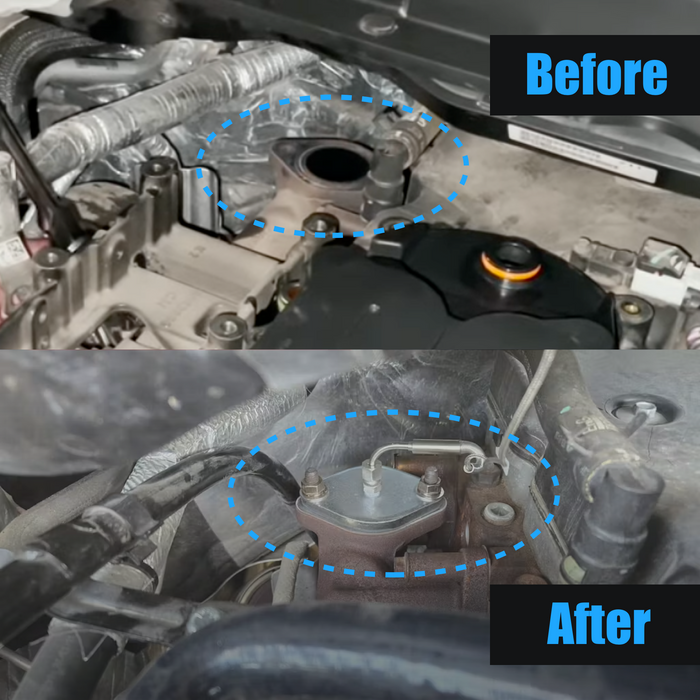
Remove the engine cover and unplug the EGR-related sensors (note which ones get plugged back in vs. which get capped).
-
Remove the EGR valve and the crossover pipe. Scrape the old gasket material clean — and don’t let the debris drop into the open intake port.
-
The EGR cooler is the fiddly part. It’s held by a mix of bolts (10mm, 13mm, 15mm depending on location), and the back bolts are buried. You don’t have to drain the entire cooling system — the EGR cooler is the highest coolant point on the engine, so if you work slowly you’ll only lose a little coolant when you crack it loose.
-
Install the block-off plates. Use the factory bolts/nuts you removed — and if a plate doesn’t cinch down tight because you’ve run out of threads, add washers as spacers. A block-off plate that’s not actually sealed is a coolant leak waiting to happen.
-
Route the coolant bypass: the kit’s hose loops the coolant lines that used to feed the EGR cooler. Get the clamps on before you tighten anything down.
Phase 3: The Throttle Valve Gets Unplugged (Don’t Skip This)
With emissions-off tuning, the throttle valve must be unplugged — it’s a small connector buried behind the intake, and you’ll want a mirror and a pick to get at its red locking tab.
Critical distinction: don’t confuse the throttle valve with the MAP sensor right next to it. The MAP sensor stays plugged in — the truck needs it.
Phase 4: The New Exhaust Goes On
-
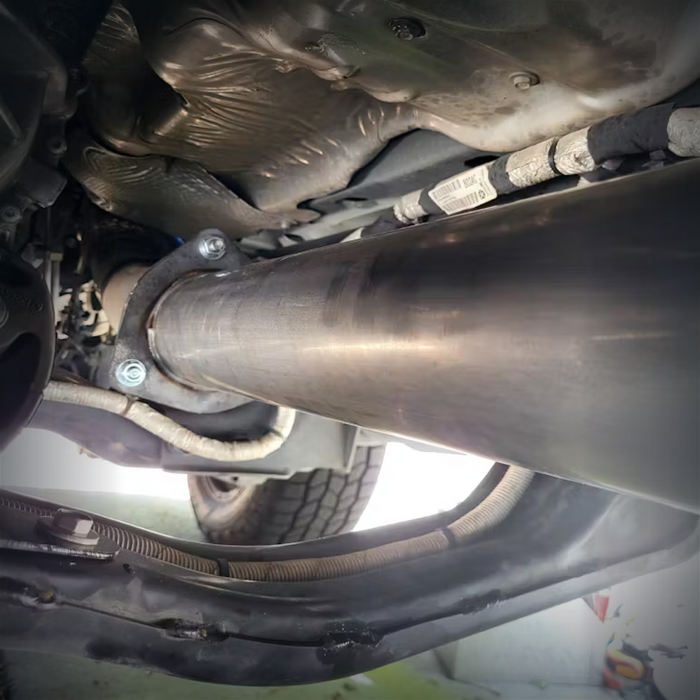
Lay out the new pipe. You’ll have extra sections for long-box / Mega Cab fitment — only use what your wheelbase needs, and don’t cut the straight-through main section (it’s beveled on both ends and needs to stay that way).
-
Mount the first section to the turbo’s V-band, but leave it loose — you want wiggle room until the whole system is assembled.
-
Work front to back, then tighten the V-band first, then all the clamps front to back.
-
Start the truck and run your (bare) hand along each clamp joint to check for exhaust leaks. If it’s sealed, you’re done underneath.
Phase 5: Cap the orphaned connectors — this matters long-term
Here’s a mistake that comes back to bite people months later, and it’s worth doing right the first time. When you remove all those DEF and sensor connectors, don’t leave them bare and exposed. They’ll wick moisture, corrode, and eventually short the 5-volt reference circuit — which then takes out other sensors that have nothing to do with emissions, and gives you a mysterious drivability problem.
Where DIY Installers Get It Wrong — How to Avoid It
Collecting the most common first-time mistakes, each with the fix:
- Removing hardware before tuning. The classic. It sends the truck into limp mode and makes a two-hour job a two-day job. Tune first, always.
- Forgetting the battery charger. Flashing an ECM with a weak battery is a recipe for a bricked module. Put a charger on it (10-amp is plenty) before you flash.
- Skipping the 2018 bypass cable. 2018 owners who don’t install it just sit there while the tuner fails to connect.
- Mixing up the throttle valve and MAP sensor. Unplug the MAP and the truck won’t idle right. Use a mirror, take your time, identify the correct connector.
- Leaving connectors exposed. The corrosion problem above. Grease and seal everything you unplug.
- Over-tightening a block-off plate or running out of threads. Add washers; don’t strip the stud.
- Hammering the truck right after tuning. The TCM/ECM memory is wiped — drive gently so the transmission re-learns. Then ease into the throttle and roll into boost rather than stabbing it.
- Towing in a high power setting. More power under load = hotter combustion = blown head gasket or smoked 68RFE. Tow in a low tune.
And one thing that’s not on the list because it’s a separate problem: the grid heater bolt. The 6.7L’s intake grid heater has a known issue where the mounting nut can corrode and drop into the intake — a catastrophic failure. It’s unrelated to the delete, but since you’ll have the intake apart anyway, it’s the perfect time to address it with a reinforced grid heater bolt/bus bar kit.
The Product: Two Pipes, Two Very Different Jobs
Here’s where the “4 inch or 5 inch” decision becomes concrete. SEGULER makes both, and they’re priced and positioned exactly the way the decision table above suggests — because they’re for two different trucks.
2013-2018 6.7L Dodge Ram Cummins 4" Diesel Tube Pipe Exhaust & Cooler Throttle EGR Valve Delete
This is the “replace the restriction, keep the factory plumbing” approach:

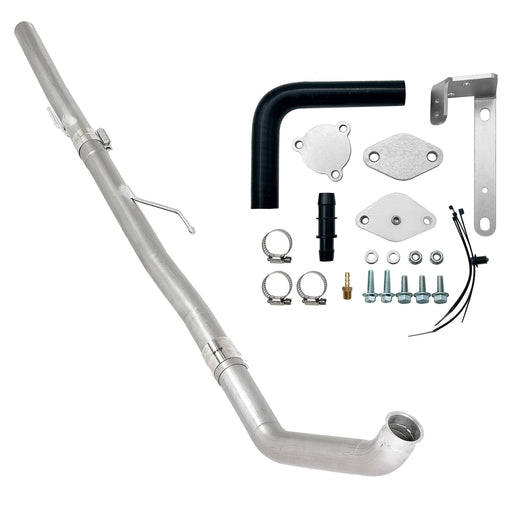
- A 4" mandrel-bent 409 stainless steel DPF/CAT race pipe replaces the factory DPF and catalyst — the single biggest restriction in the exhaust.
- It bolts directly to your existing factory tailpipe using the original rubber hanger mounts, so you’re not paying for pipe you already have.
- Full EGR cooler, crossover tube, and actuator delete, plus a smooth-bore throttle valve delete tube.
- Stops active regen cycles entirely — no more fuel-wasting regeneration.
This is the 4" argument in one product:
It removes the choke points that matter, keeps the parts that don’t need replacing, and costs $299. For a daily driver or tow rig, this is the value play. The mandrel-bent 409 stainless matters here — a crush-bent pipe narrows at every curve and kills the flow you just bought, while 409 SS is the same grade OEMs use for factory diesel exhaust, so it’ll outlast aluminized steel in a salt state.
5" Turbo Back DPF Delete Pipe & EGR Cooler Delete Kit for 2013-2018 6.7L Ram Cummins
This is the “open up the entire path” approach:

- A full 5" turbo-back system replaces the downpipe, catalytic converter, and DPF — the entire exhaust path from the turbocharger housing to the tailpipe.
- Includes EGR block-off plates, coolant bypass hardware, and a billet standpipe adapter for a complete, leak-free EGR elimination.
- The deeper, bassier 5" tone, and maximum EGT reduction under heavy load.
- Requires custom delete tuning (EZ Lynk or Mini Maxx flashed with delete-capable software) — which you need regardless.
Here’s the key difference the product page states directly:
The 4" race pipe replaces only the DPF section and keeps the restrictive stock downpipe. The 5" turbo-back replaces the downpipe too. That’s the real distinction — not just “bigger,” but complete. It’s why the 5" costs more and why it’s the choice for a build that’s actually chasing flow, not just a louder idle.
Which One Do You Buy?
It maps cleanly onto the decision table at the top:
-
Daily driver, tow rig, budget-conscious, drone-sensitive → the 4". You get the single biggest flow gain and all the reliability benefits for a third of the price, and you keep the factory tailpipe.
-
High-output build, want maximum sound and flow, willing to replace the downpipe → the 5" . You’re paying for the complete path and the deeper tone.
Both require delete tuning, and both fit the 2013-2018 Ram 2500/3500 pickup (not the commercial Cab & Chassis, and the 5" specifically doesn’t fit trucks with the factory rear air suspension). Match your year, your transmission, and your intended use before you order.
The Bottom Line
If you own a 2013-2018 6.7L Cummins and you’re weighing a DPF and EGR delete, you’re starting from the strongest position in the diesel truck world: a rock-solid CP3-fed engine whose only real annoyance is the emissions system bolted around it. Removing that system is a quality-of-life upgrade, not a rescue mission — and the single biggest decision in the whole job is the one in your title.
-
Choose the 4" if you drive, tow, or work this truck and want the biggest reliability and flow gain for the least money and the least drone. It removes the choke point that matters, keeps the parts that don’t need replacing, and costs a third of the big-pipe option.
-
Choose the 5" if you’re building a genuine high-output truck and want the complete turbo-back path, the deeper tone, and maximum EGT headroom — and you’re willing to pay for it and live with the drone.
At SEGULER, we build delete hardware specifically for these trucks — the 4" DPF/CAT race pipe with EGR and throttle valve delete for the daily-driver build, and the 5" turbo-back with full EGR cooler elimination for the all-out build. Both are in stock, ready to ship, and engineered for the 2013-2018 Ram 2500/3500 pickup. If you’re not sure which fits your truck and your goals, check the fitment notes, match your transmission and year, and pick the pipe that matches how you actually use the truck.
Frequently Asked Questions
Q1: Do I really need a tune, or can I just remove the parts?
You need a tune. Removing the emissions hardware without flashing a delete-capable calibration will throw a wall of codes and put the truck into limp mode. The tune is what tells the ECM the emissions systems are gone, suppresses the DTCs, and prevents derate. This is non-negotiable.
Q2: Is the 5" worth the extra money over the 4"?
Only if you’re actually using the flow. For a daily driver or tow rig on a mild-to-moderate tune, the 4" delivers the overwhelming majority of the benefit for a third of the price, with less cab drone and an easier install. The 5" earns its cost on a high-output build that needs the complete turbo-back path and the deeper tone.
Q3: Will a delete hurt my transmission?
Not by itself — but the tune can, if you run a hot setting on a stock 68RFE. The 68RFE is the weak link, not the engine. Get transmission tuning built into your delete tune, tow in a low power setting, and drive gently until the TCM re-learns after flashing.
Q4: Why does my truck shift weird right after I tune it?
Because on the 6.7L Cummins the TCM and ECM are one unit, and flashing the tune wipes the transmission’s adaptive memory. Drive it normally for a few dozen miles and the shift points re-learn themselves.
Q5: What’s different about the 2018 model year?
The 2018 has a Security Gateway Module (SGW) that blocks unauthorized CAN-bus communication. You need a bypass cable installed before you can flash the ECM. The 2013-2017 trucks plug straight into the OBD-II port.
Q6: Do I have to remove the EGR, or can I just leave it?
You can leave the EGR in place and simply unplug it once the truck is tuned — but the EGR cooler is a known failure point that cracks over time and mimics a blown head gasket. Removing it (and installing the block-off plates) eliminates that failure mode entirely and frees up engine-bay space. We recommend removing it.
Q7: Is this legal for my truck?
On a vehicle driven on public roads, no — removing emissions equipment violates the federal Clean Air Act and voids your emissions warranty. This modification is for off-road, competition, or otherwise-exempt use only. Check your local and state laws before doing anything.
Q8: Will I actually gain horsepower from the delete?
The delete itself removes restrictions and failure modes — the horsepower comes from the accompanying tune. A typical 2013-2018 delete + tune adds roughly 60-120 horsepower and 150-200 lb-ft, with the exact number depending on the tune level. The delete’s real value is reliability and cooler running, not raw power.
Q9: What fuel economy can I expect?
Real-world reports vary, but the honest answer is a modest, consistent gain — roughly 1-3 MPG in normal driving, with the biggest improvements coming from eliminating regen fuel burn and DEF. Don’t believe the “plus 7 MPG” hype. Owners who drive gently in a moderate tune see the best numbers.
Q10: What’s the grid heater bolt problem I keep hearing about?
It’s a separate issue from the delete: the 6.7L’s intake grid heater has a nut that can corrode and drop into the intake, causing catastrophic engine damage. It’s cheap insurance to install a reinforced grid heater bolt/bus bar kit while you have the intake apart for the EGR delete.
Featured collection
-
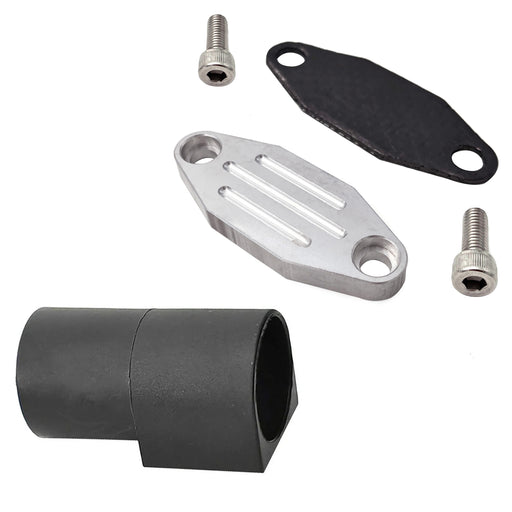
Seguler 1986-1995 Ford F150 F250 F350 Mustang Trucks EGR Simulator Eliminator / Block Off Plate Kit
SEGULEROriginal price $79.99 - Original price $79.99Original price$79.99$79.99 - $79.99Current price $79.99Block Off Plate Material: Aluminum alloy. Easy installation,and convenient to use. Made of CNC milled from aircraft grade Billet aluminum. Will N...
View full details -

Seguler 2011-2023 6.7L Ford Powerstroke Diesel EGR Delete Kit
SEGULEROriginal price $109.99 - Original price $109.99Original price$109.99$109.99 - $109.99Current price $109.99FITMENT 2011-2023 6.7L Ford Powerstroke F-250 F-350 F-450 F-550 Super Duty V8 Diesel. compatible with both standard Pickups and commercial Cab &...
View full details -
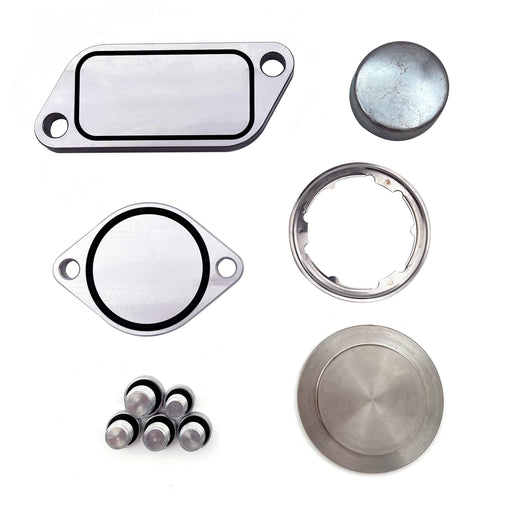
For 2010-Present Stage 2 ISX 15 CM2250 CM2350 EGR Delete Kit
SEGULEROriginal price $59.99 - Original price $59.99Original price$59.99$59.99 - $59.99Current price $59.99FITMENT 2010-Present Cummins Volvo, Peterbilt, Mack, International, Freightliner, Kenworth with the ISX15 CM2250 / CM2350 engines. DESCRIPTION P...
View full details -
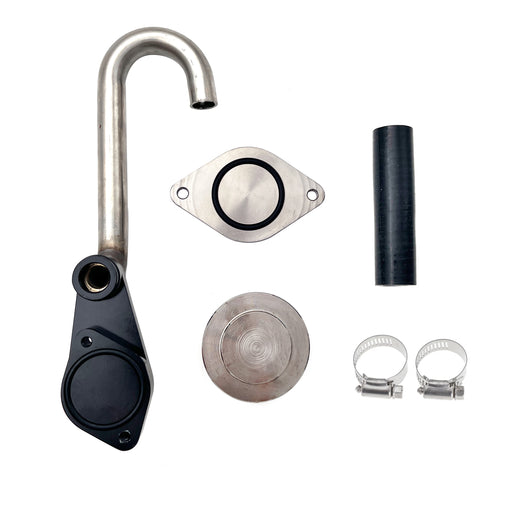
Seguler 2003-2007 6.0L FORD Powerstroke Diesel EGR Cooler Delete Kit
SEGULEROriginal price $56.14 - Original price $56.14Original price$56.14$56.14 - $56.14Current price $56.14FITMENT 2003-2007 6.0L Ford F-250 Ford F-350 F-450 F-550 Super Duty. 2003-2007 6.0L Ford Excursion SUV (Diesel Models Only). 2005-2010 Ford E-Se...
View full details -
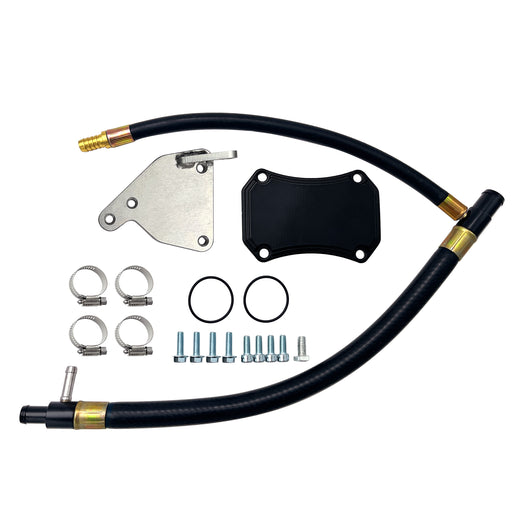
For 2011-2016 6.6L GMC Chevy Duramax Diesel LML EGR Valve Cooler Delete Kit
SEGULEROriginal price $66.49 - Original price $66.49Original price$66.49$66.49 - $66.49Current price $66.49FITMENT 2011-2016 6.6L Chevy GMC Duramax LML 2500 HD 3500 HD Diesel. DESCRIPTION Product Overview The 2011–2016 LML Duramax uses a complex EG...
View full details -
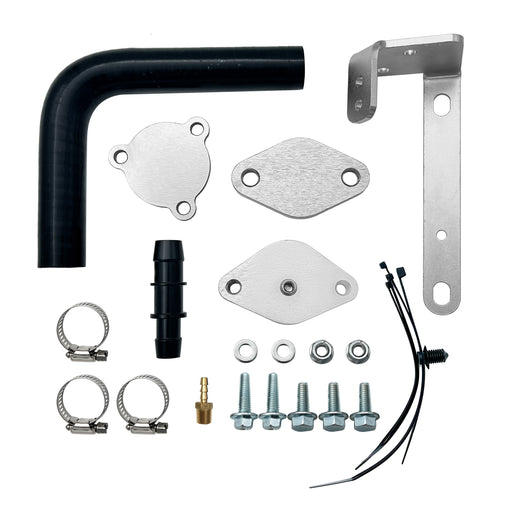
Seguler For 2014-2019 3.0L Dodge Ram 1500 EcoDiesel EGR Valve & Cooler Delete Kit
SEGULEROriginal price $72.99 - Original price $72.99Original price$72.99$72.99 - $72.99Current price $72.99FITMENT 2014-2019 3.0L Dodge Ram 1500 EcoDiesel V6 engine trucks. DESCRIPTION Product Overview Exhaust gas recirculation on 3.0L EcoDiesel V6 ...
View full details -

Seguler 2011-2023 6.7L Ford Powerstroke Diesel EGR Delete Kit
SEGULEROriginal price $85.99 - Original price $85.99Original price$85.99$85.99 - $85.99Current price $85.99FITMENT 2011-2023 6.7L Ford Powerstroke F-250 F-350 F-450 F-550 Super Duty V8 Diesel. compatible with both standard Pickups and commercial Cab &...
View full details -
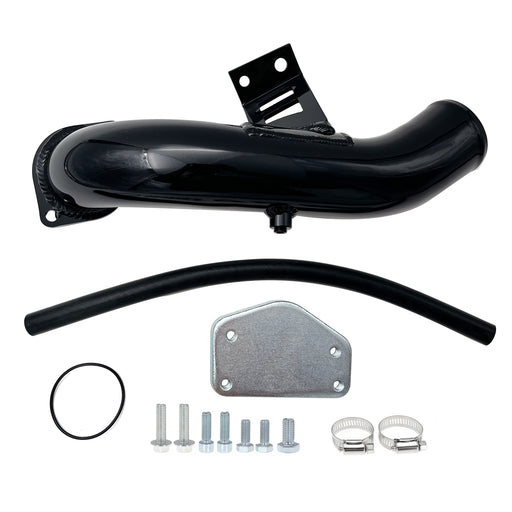
For 2004.5-2005 6.6L Chevy GMC Silverado LLY Duramax Diesel EGR Delete Kit
SEGULEROriginal price $92.99 - Original price $92.99Original price$92.99$92.99 - $92.99Current price $92.99FITMENT 2004.5-2005 6.6L Chevrolet Silverado Duramax LLY 2500HD / 3500 HD. 2004.5-2005 6.6L GMC Sierra Duramax LLY 2500HD / 3500 HD. DESCRIPTION...
View full details -

Seguler 2010-2024 6.7L Dodge Ram Cummins Diesel EGR Valve Cooler Delete Kit
SEGULEROriginal price $89.99 - Original price $89.99Original price$89.99$89.99 - $89.99Current price $89.99FITMENT 2010–2024 6.7L Dodge Ram Cummins 2500 / 3500 Pickup Turbo Diesel. Note: Does NOT fit Chassis Cab 3500 / 4500 / 5500 models. DESCRIPTIO...
View full details -

Seguler 2017-2019 L5P Duramax Diesel 4pcs L5P Can Bus Plugs Connector Replacement
SEGULEROriginal price $75.00 - Original price $75.00Original price$75.00$75.00 - $75.00Current price $75.00FITMENT 2017–2019 Chevrolet Silverado / GMC Sierra Duramax L5P 2500HD & 3500HD Diesel. DESCRIPTION Product Overview Unprotected harness con...
View full details -

Seguler 2020-2023 chevy duramax L5P Diesel Can Bus Plugs Connector
SEGULEROriginal price $80.00 - Original price $80.00Original price$80.00$80.00 - $80.00Current price $80.00FITMENT 2020–2023 Chevrolet Silverado / GMC Sierra Duramax L5P 2500HD & 3500HD Diesel. DESCRIPTION Product Overview Unprotected harness pl...
View full details -
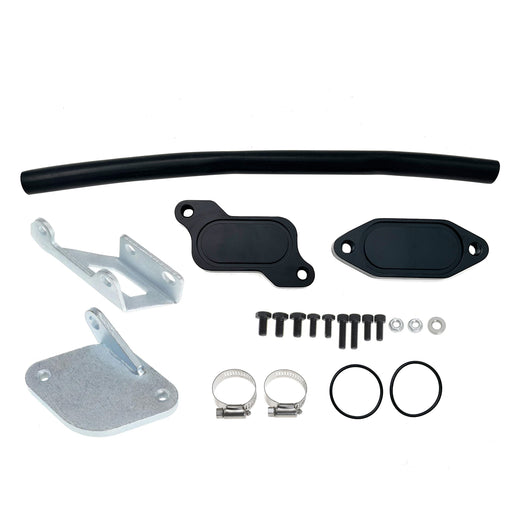
For 2006-2007 6.6L Chevrolet Silverado Classic GMC Duramax LBZ Diesel EGR Valve Cooler Delete Kit
SEGULEROriginal price $63.49 - Original price $63.49Original price$63.49$63.49 - $63.49Current price $63.49FITMENT 2006-2007.4 Chevrolet Silverado Duramax LBZ 2500HD / 3500HD. 2007.4 Chevrolet Silverado Duramax LBZ 2500HD / 3500HD Classic. 2006-2007.4 ...
View full details -
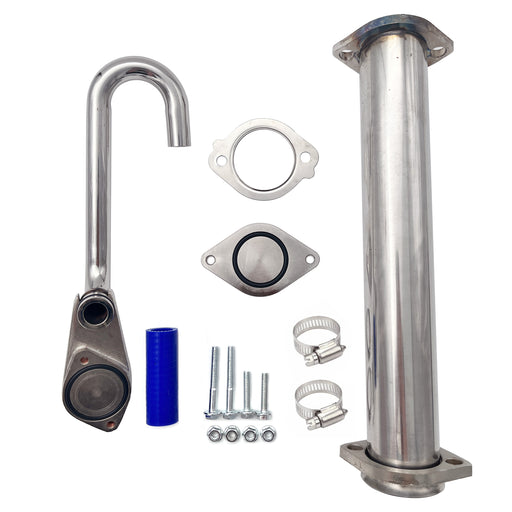
Seguler 2003-2007 6.0L Ford F250 F350 Powerstroke Diesel EGR Basic Cooler Kit
SEGULEROriginal price $79.99 - Original price $79.99Original price$79.99$79.99 - $79.99Current price $79.99FITMENT 2003-2007 6.0L Ford F250 F350 F450 F550 Super Duty Turbo (except 2004 F250 Super Duty). 2003-2005 6.0L Ford Excursion Turbo. 2005 Ford F...
View full details -

Seguler 2011-2023 6.7L Ford F250 F350 F450 F550 Powerstroke Diesel EGR Valve Delete Cooler Delete Kit
SEGULEROriginal price $55.99 - Original price $55.99Original price$55.99$55.99 - $55.99Current price $55.99FITMENT 2011-2023 6.7L Ford Powerstroke F-250 F-350 F-450 F-550 Super Duty V8 Diesel compatible with both standard Pickups and commercial Cab &a...
View full details -
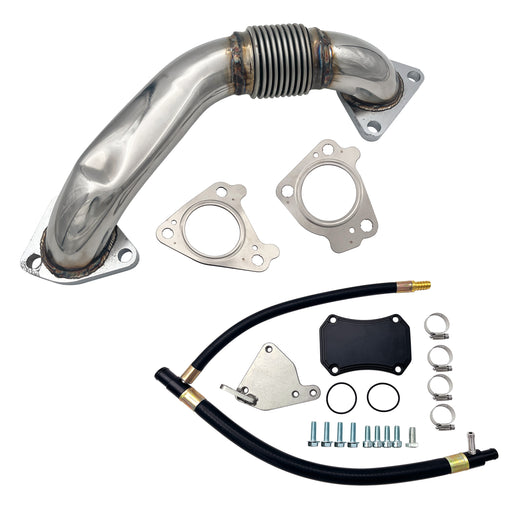
Seguler 2011-2016 6.6L GMC Chevy Duramax Diesel LML Up-Pipe & EGR Valve Cooler Delete Kit
SEGULEROriginal price $173.86 - Original price $173.86Original price$173.86$173.86 - $173.86Current price $173.86FITMENT 2011-2016 6.6L Chevy GMC Duramax LML 2500 HD 3500 HD Diesel. DESCRIPTION Product Overview Direct-injection technology endows GM 5.3L an...
View full details -
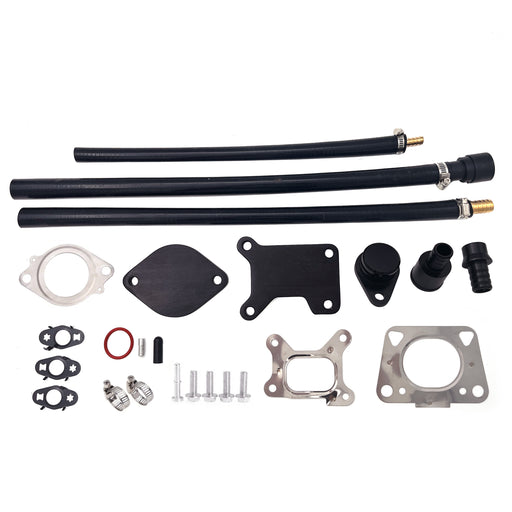
For 2017-2023 6.6L Chevy GMC Duramax L5P diesel EGR Valve Cooler Delete kit
SEGULEROriginal price $131.99 - Original price $131.99Original price$131.99$131.99 - $131.99Current price $131.99FITMENT 2017–2023 6.6L Chevrolet Silverado / GMC Sierra Duramax L5P 2500HD 3500HD Diesel. DESCRIPTION Product Overview Hot soot recirculation ...
View full details -

For 2013-2023 6.7L Dodge Ram Cummins Cab & Chassis EGR Delete Kit Diesel
SEGULEROriginal price $62.99 - Original price $62.99Original price$62.99$62.99 - $62.99Current price $62.99FITMENT 2013–2023 6.7L Ram Cummins 3500 4500 5500 Cab & Chassis / Commercial Trucks. Does NOT fit standard Ram 2500 3500 Pickups. DESCRIPTIO...
View full details -
Seguler 3" Ecodiesel DPF Delete Pipe & EGR Delete kit for 2014-2018 3.0L Ram
SEGULEROriginal price $342.00 - Original price $342.00Original price$342.00$342.00 - $342.00Current price $342.00FITMENT 2014–2018 3.0L Dodge Ram 1500 EcoDiesel V6. NOTE: Fit standard Pickup models only (Crew Cab, Quad Cab). Does NOT fit Jeep Grand Cheroke...
View full details -
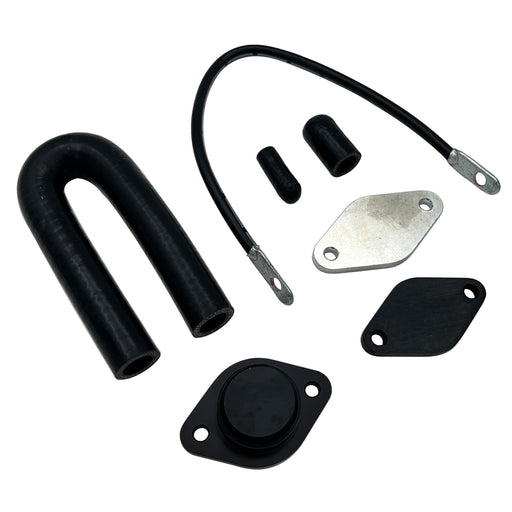
Seguler EGR valve cooler Delete kit for 2020-2022 3.0L Chevy Duramax LM2
SEGULEROriginal price $189.12 - Original price $189.12Original price$189.12$189.12 - $189.12Current price $189.12FITMENT 2020–2022 3.0L Chevrolet Silverado GMC Sierra 1500 LM2 Turbo-Diesel. DESCRIPTION Product Overview Powered by smooth inline-six engine...
View full details -
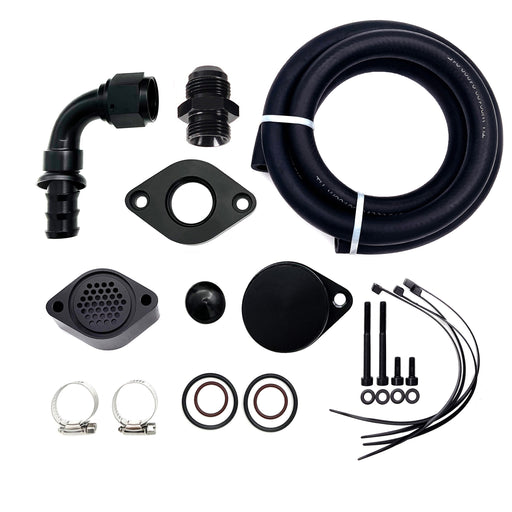
Seguler 2011-2023 6.7L Ford Powerstroke CCV PCV Reroute Engine Ventilation Kit
SEGULEROriginal price $82.99 - Original price $82.99Original price$82.99$82.99 - $82.99Current price $82.99FITMENT 2011-2023 6.7L Ford Powerstroke F-250 F-350 F-450 F-550 Super Duty V8 Diesel. Compatible with both standard Pickups and commercial Cab &...
View full details -
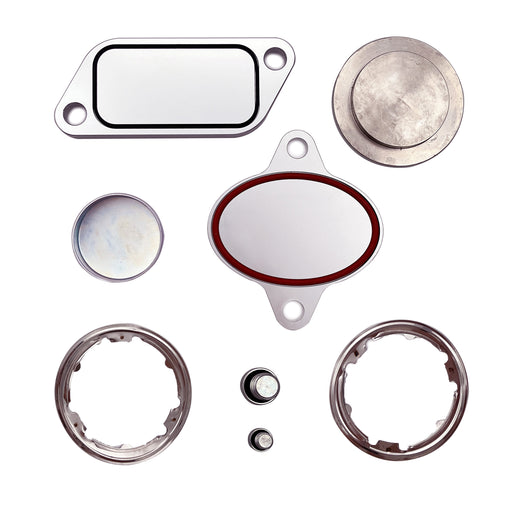
For 2007-2010 Cummins ISX CM871 EGR Plug Kit Stage 2 Plates and Plugs Aluminum
SEGULEROriginal price $67.99 - Original price $67.99Original price$67.99$67.99 - $67.99Current price $67.99FITMENT 2007-2010 Cummins Volvo, Peterbilt, Mack, International, Freightliner, Kenworth with the ISX CM871 Engines. DESCRIPTION Product Overvie...
View full details -
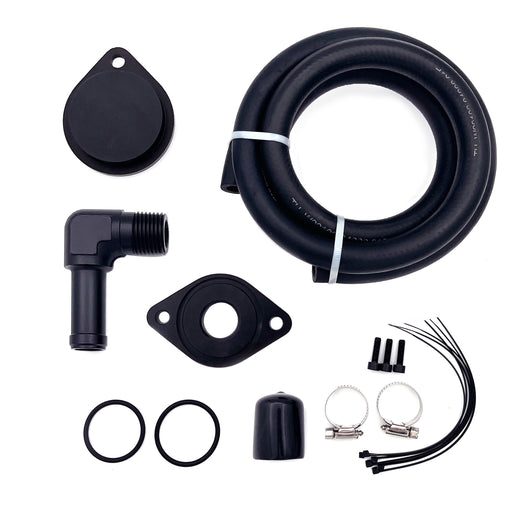
Seguler 2011-2023 Ford 6.7L Powerstroke CCV/PCV Reroute/Delete Engine Ventilation Kit
SEGULEROriginal price $72.00 - Original price $72.00Original price$72.00$72.00 - $72.00Current price $72.00FITMENT 2011-2023 6.7L Ford Powerstroke F-250 F-350 F-450 F-550 Super Duty V8 Diesel. Compatible with both standard Pickups and commercial Cab &...
View full details -
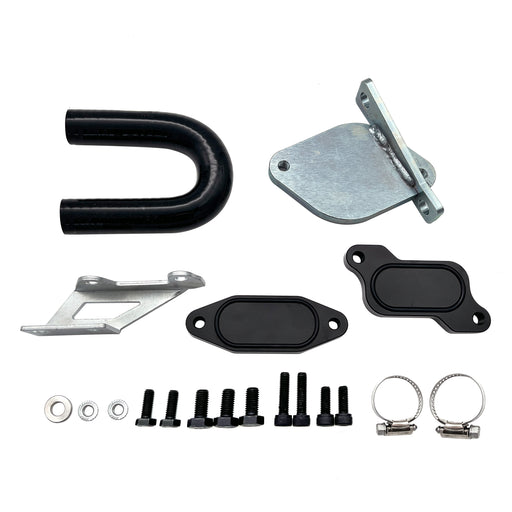
For 2007-2010 6.6L Chevy GMC LMM Duramax EGR Valve Cooler Delete Kit Fit
SEGULEROriginal price $61.99 - Original price $61.99Original price$61.99$61.99 - $61.99Current price $61.99FITMENT 2007.5-2010 6.6L Chevrolet Silverado Duramax LMM 2500HD / 3500HD. 2007.5-2010 6.6L GMC Sierra Duramax LMM 2500HD / 3500HD. Note: Standard...
View full details -
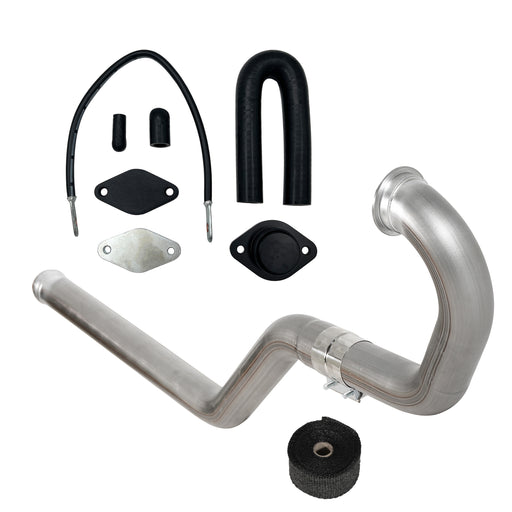
3" Turbo Back DPF & EGR Delete Kit for 2020-2022 GM 3.0L LM2 Duramax
SEGULEROriginal price $550.00 - Original price $550.00Original price$550.00$550.00 - $550.00Current price $550.00FITMENT 2020–2022 3.0L Chevrolet Silverado 1500 LM2 Diesel. 2020–2022 3.0L GMC Sierra 1500 LM2 Diesel. DESCRIPTION Product Overview On the 3.0...
View full details -
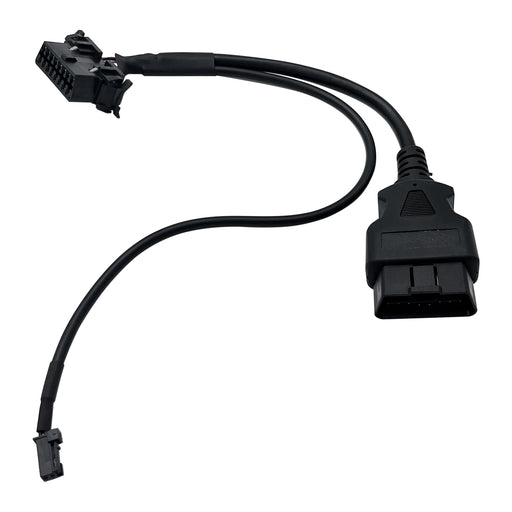
Seguler 2018+ RAM Cummins OBD2 HD Security Gate Bypass Cable
SEGULEROriginal price $45.00 - Original price $45.00Original price$45.00$45.00 - $45.00Current price $45.00FITMENT 2018+ 6.7L Ram Cummins 2500 3500 Turbo Diesel. Designed for Ram pickup trucks equipped with the factory Security Gateway Module. Note: Pl...
View full details


Leave a comment